Closing the loop: What the EU’s new ELV rules mean for automakers and suppliers
What's in this article
After nearly three years of negotiations, the new European Union ELV regulation formally came into force in August. While many of its provisions will be phased in over the coming years, the regulation is set to reshape new vehicle development, material sourcing and recycling strategies across the automotive value chain. More importantly, it marks a fundamental shift in how Europe views vehicles: Not as products that eventually become waste, but as reservoirs of valuable materials that can be recovered and reused in future vehicles.
The new regulation replaces both the ELV Directive 2000/53/EC and the 3R Type Approval Directive 2005/64/EC, which were introduced in 2000 and 2005, respectively. The previous framework focused primarily on vehicle collection, environmentally sound disposal, restrictions on hazardous substances and recycling targets. By contrast, the new regulation extends coverage across the entire vehicle life cycle, from material selection and design through dismantling, reuse and recycling.
The most significant difference is the introduction of mandatory recycled-content requirements. New vehicles sold in Europe must contain at least 15% recycled plastic content from 2032, increasing to 25% by 2036. A portion of that recycled content must come directly from ELVs, embedding closed-loop recycling into the sector. The regulation also establishes a framework for future recycled-content targets for steel and aluminum, signaling that metals will gradually be brought under similar circularity expectations.
The regulation introduces stronger traceability requirements, digital documentation, design-for-dismantling obligations and expanded producer responsibility. Together, these provisions are designed to improve both supply and demand for recycled materials, shifting the focus from end‑of‑life waste management to proactive material management and creating a more functioning circular economy for automotive resources.
Rising plastic use in vehicles
Plastic use in modern vehicles has increased rapidly over the past 50 years, driven by the need to reduce weight, improve fuel efficiency, lower emissions, enhance safety and provide greater design flexibility. Today, plastics account for nearly 20% of a vehicle’s weight and are used throughout the vehicle, from dashboards, door panels and seating systems to bumpers, fuel systems and EV battery components.
Despite their advantages, plastics present a significant end-of-life problem. While steel and aluminum are routinely recovered and recycled at high rates, a large share of automotive plastics continues to be incinerated, landfilled or downcycled into lower-value applications.
A modern vehicle contains dozens of polymer grades, often combined with adhesives, coatings, foams, fibers and fillers. A single instrument panel may incorporate polypropylene, polyurethane foam, decorative skins, electronic components and fastening systems. Economically separating these combinations at scale is extremely difficult, which limits high-quality recycling outcomes.
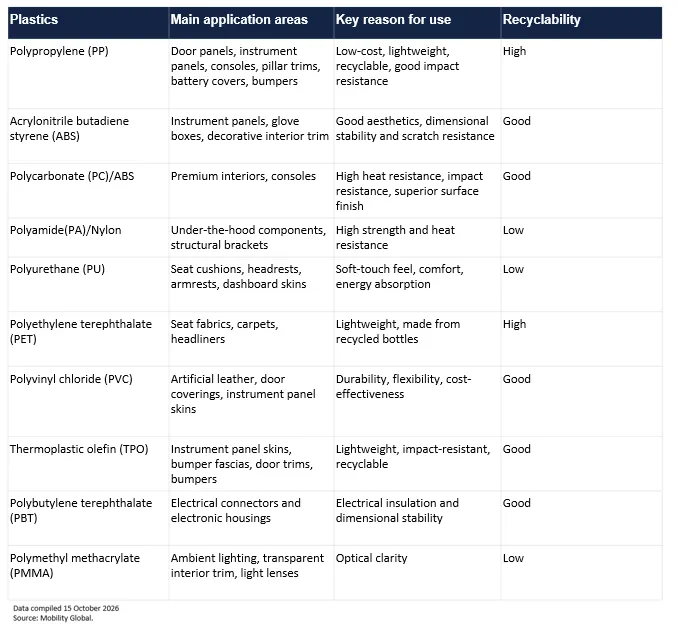
Key plastics used in vehicles
Mechanical or chemical recycling
Not all plastics are equally recyclable. While thermoplastics such as polypropylene (PP), acrylonitrile butadiene styrene (ABS), polyethylene terephthalate (PET) and nylon can typically be remelted and reused, thermosets, polyurethane (PU) foams and many composite materials cannot be easily reprocessed once cured and often require specialized recycling technologies that are not yet available at industrial scale.
Addressing this challenge will be critical for automakers and suppliers seeking to meet the EU's new ELV requirements. Two approaches are emerging as particularly important: mechanical and chemical recycling. Mechanical recycling, which involves collecting, sorting and remelting plastics into new materials, is currently the most mature, economical and scalable option for recovering high-volume automotive plastics such as PP, ABS and PET. As a result, it is expected to play the primary role in helping the industry achieve the first recycled-content targets that take effect from 2032.
Chemical recycling takes a different approach by breaking plastics down into their chemical building blocks and converting them back into near-virgin-quality polymers. Although more expensive and less mature commercially, it offers a potential solution for mixed, contaminated and difficult-to-recycle plastic waste streams. The most pragmatic industry strategy is likely to be a combination of the two: mechanical recycling to meet near-term compliance targets and chemical recycling to support longer-term circularity goals and true vehicle-to-vehicle closed-loop recycling.
The importance of these technologies has risen sharply under the EU's new ELV Regulation. Unlike the original ELV Directive, which focused largely on recycling rates and hazardous substances, the new framework addresses the entire vehicle lifecycle, from design and production to dismantling, reuse and material recovery.
The final regulation is less ambitious than the European Commission's original 2023 proposal, which sought to mandate 25% recycled-plastic content with a significant share sourced directly from end-of-life vehicles. Following negotiations with automakers, suppliers and chemical companies, implementation timelines were extended and some requirements softened. Even so, the regulation marks a decisive shift, elevating circularity from a sustainability objective to a strategic requirement for future vehicle development.
Compliance challenges
Meeting the recycled-content target under the new regulations will not be just a volume problem. For automakers and suppliers, the challenge is multidimensional, spanning materials, data and industrial capacity. The biggest challenge will be building reliable supply chains for automotive‑grade recycled materials.
Unlike packaging or consumer goods, automotive components must meet rigorous standards for durability, appearance, impact resistance and safety. Recycled plastics often exhibit greater variability than virgin materials, making qualification and validation significantly more complex. As a result, the industry’s primary challenge is shifting from simply sourcing recycled materials to industrializing them to consistently meet automotive-grade quality standards.
The second challenge is traceability. Regulators are increasingly interested not simply in whether recycled content exists, but where it originates and how it is verified. This will require digital material‑passport systems, enhanced supplier transparency and new compliance infrastructures extending across multiple tiers of the supply base. For many OEMs, this implies embedding sustainability data into existing quality and procurement systems, rather than treating it as a separate reporting layer.
The third challenge is capacity. Europe lacks sufficient closed‑loop automotive recycling infrastructure to support future demand. Significant investments will be required in dismantling, sorting, material recovery and compounding operations before regulatory deadlines begin to bite. Without this infrastructure, recycled-content targets risk becoming constrained by supply rather than ambition.
Opportunity for suppliers
While the new ELV regulation presents a strategic challenge for OEMs, it may unlock growth opportunities for suppliers. Interior systems are expected to become the primary route through which automakers meet future recycled‑content requirements. Dashboards, door panels, center consoles, headliners and seating structures account for substantial volumes of vehicle plastics and therefore, represent the most practical areas for circular-material integration. In effect, the cabin becomes the main arena for visible, verifiable recycled content.
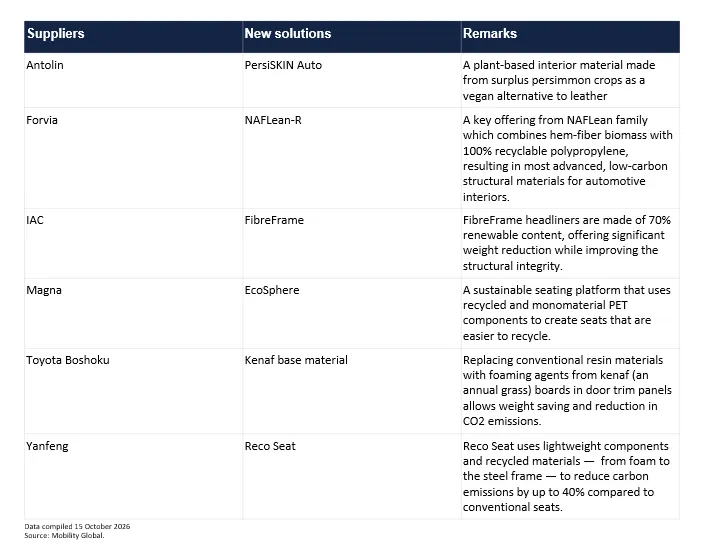
Leading auto parts suppliers are already positioning accordingly. For example, Forvia established a dedicated business division called MATERI’ACT to develop sustainable materials for automotive applications and is investing heavily in recycled and bio-based materials. Antolin has developed ECover, which uses 100% recyclable monomaterials, and PersiSKIN Auto, a plant-based interior material made from surplus persimmon crops as a vegan alternative to leather.
Other interior suppliers are also actively working in this field. Yanfeng is developing recycled-plastic interior architectures and bamboo-based solutions, while IAC Group, Magna and Toyoda Gosei are pursuing natural-fiber composites, mono-material systems and automotive-grade recycled polymers. These initiatives are no longer niche sustainability programs; they are becoming core elements of future product strategies. For tier 1 suppliers, material innovation is evolving from a differentiator into a prerequisite for long-term OEM partnerships.
Table: New sustainable solutions launched by key suppliers
Will other regions follow the EU?
Europe is unlikely to remain an outlier for long. The forces driving the ELV regulation are not uniquely European. Concerns over resource security, supply chain resilience and raw material dependency are increasingly shaping policy discussions in mainland China, North America and Japan.
Even if other markets stop short of imposing explicit recycled-content mandates, they are moving in the same strategic direction. Packaging, batteries and industrial products are already seeing increasing recycled-content requirements, suggesting that automotive applications may eventually follow.
In practice, OEMs themselves may accelerate convergence. Maintaining separate material strategies for Europe and the rest of the world would introduce unnecessary complexity. Once recycled-material solutions are validated for European programs, they are likely to be deployed globally. Europe may therefore be setting the template for future automotive material regulation worldwide. For global automakers, this raises the likelihood that “European-standard” material strategies become the norm across key markets, regardless of local regulatory timelines.
Conclusion
The new ELV regulation represents far more than a new recycling mandate. It signals the beginning of a structural shift in how the automotive industry will source, manage and recover materials over the coming decades.
Historically, vehicle competitiveness was determined by manufacturing scale, engineering capability and supplier relationships. Increasingly, it will also depend on access to recycled materials, traceable supply chains and circular‑design capabilities. In this respect, the ELV regulation mirrors the strategic rationale behind Europe's battery, semiconductor and critical-raw-material initiatives: reducing external dependencies while strengthening domestic industrial resilience.
The biggest risk for automakers is not the regulatory targets themselves. The real challenge lies in securing high‑quality recycled feedstocks, validating those materials for automotive applications and building the digital infrastructure needed to verify compliance across increasingly complex supply chains. Those who treat ELV compliance as a narrow regulatory exercise risk falling behind competitors who use it as a catalyst for broader supply chain transformation.
For suppliers, however, the regulation creates a significant growth opportunity. Companies capable of delivering recycled‑content solutions, bio‑based materials, closed‑loop recycling technologies, and circular-design expertise will move from component suppliers to strategic partners in OEM sustainability and compliance roadmaps. This shift has direct implications for capital allocation, research and development priorities and long-term contract structures across the supplier base.
At its core, the ELV regulation is best understood as an industrial transformation program disguised as environmental legislation. Ten years from now, the industry's competitive landscape is likely to be shaped not only by who builds the best vehicles, but also by who controls the most resilient and circular material ecosystems. Vehicles reaching end of life will increasingly be viewed less as waste streams and more as valuable reservoirs of future raw materials. That is the long-term significance of the regulation.
Author: Om Prakash Sharma, Principal Research Analyst, Mobility Global