.png?ext=.png)
在追求更快、更智能充电技术的竞赛中,中国如何成为电动汽车行业下一次重大飞跃的核心。
In [mainland] China's hypercompetitive market, any technological advancement achieved by one brand is quickly surpassed by rivals, a pace that Western global automakers find challenging to match.
The race to develop ultrafast chargers for electric cars started around 2022, when at an event, Chinese electric carmaker XPeng launched its S4 ultrafast supercharging technology. At the event in Guangzhou, the company organized a ‘live’ demonstration of charging its electric SUV G9 with its S4 supercharger, which delivered a Chinese light-duty test cycle (CLTC) range of 210 kms in just 5 minutes of charging.
It was then Xpeng Chairman and CEO He Xiaopeng took the spotlight and compared the performance of its S4 supercharging pile with Tesla’s then available V3 Supercharger and Porsche’s Turbo Supercharging pile.
While XPeng’s S4 supercharger boasted of a maximum power of 480 kW and a maximum current flow rate of 670A, Tesla V3 Superchargers and Porsche’s Turbo Supercharging pile delivered a maximum power of 250 kW (maximum current flow rate of 631A) and 350 kW (maximum current flow rate of 500A) respectively. Both Tesla and Porsche’s fast chargers could deliver shorter driving range in 5 minutes of charging time when compared to XPeng’s S4 supercharger.
Almost three years later, more companies from [mainland] China are stepping up to unveil their superfast charging solutions, all thanks to continuous enhancement of charging technologies with an aim of reducing the charging time.
It is known that while lack of adequate EV charging infrastructure continues to be the key roadblock in the global mass adoption of EVs, long charging durations, which also cause unavailability of public EV charging spaces, is emerging to be a strategic deterrent for people buying EVs.
High-power ultrafast chargers or supercharging piles are not the sole answer to this problem. While fast-charging EVs is key to significantly cutting down the charging times, to appropriately handle the high flow of current from the grid to the vehicle’s batteries, automakers have been lately developing dedicated 800V architectures, as against the more popular and affordable 400V platforms, comprising several components such as high-voltage battery pack, electric motors, inverters, onboard chargers, DC-DC converters and efficient thermal management systems.
The development of 800V architectures was first seen in [mainland] China, and the technology has been picked up by western automakers as well.
However, technology innovations in [mainland] China continues to move at a breakneck pace.
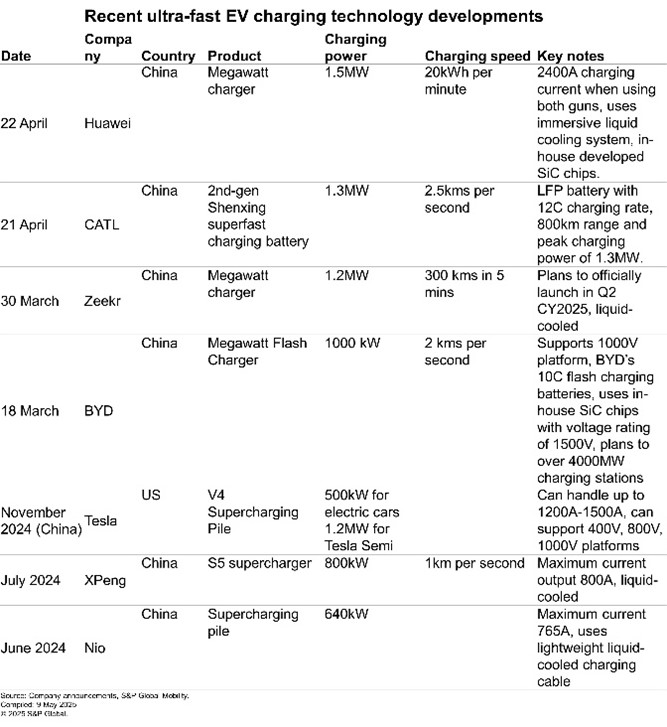
On March 17, China’s largest EV maker, BYD, launched an all-new Super e-Platform, which features flash-charging batteries, a 30,000 rpm electric motor, a new in-house designed silicon carbide (SiC) power chip, among other parts, to upgrade the core components in an EV to achieve a charging power of 1 megawatt (1000 kW) and a peak charging speed of 2 kms per second. The company said that its newly developed platform can deliver up to 400 kms of driving range within 5 minutes of charging time — the fastest charging mechanism available in mass produced vehicles. According to the company, the BYD Super e-Platform is the world’s first mass-produced 1000V high-voltage architecture for passenger vehicles.
This has come at a time when almost every other global automaker from the US, Europe, Japan, South Korea and other markets is still taking time to settle the 800V architectures in their respective portfolios. For example, Tesla mainly uses 400V architecture that supports charging EVs at up to 250 kW. That said, the newly launched Cybertruck (pickup) and Semi (electric truck) are developed on 800V and 1000V electrical platforms, respectively.
To achieve a faster flow of current inside the battery pack, BYD has reduced the internal resistance by 50% in its flash charging battery, achieving charging current of 1000A and charging rate of 10C. Notably, the C-rate is a measure of the speed at which a battery can be fully charged or discharged relative to its maximum capacity. While 1C would mean that a battery could be fully charged in 1 hour, 10C would mean that the battery can be fully charged in just 1/10th of an hour, which would be roughly 6 minutes. Therefore, the higher the C-rate, the faster a battery can be charged — a parameter equally important as a fast-charging pile.
According to BYD Chairman Wang Chuanfu, the development of the Super e-Platform is aimed at making the EV charging process as quick and as convenient as refueling a gasoline car.
At the China EV10 Forum 2025, which was organized in Beijing between March 28-30, Zeekr, Geely’s premium electric car unit, unveiled its plans to launch a fully liquid-cooled ultrafast charging pile that could deliver a peak power of 1.2MW per charging gun. The charging pile was later showcased at Auto Shanghai 2025 in April.
The 1.2MW ultrafast charger from Zeekr is the result of continuous advancement by its in-house team of engineers, upgrading the first-generation 360 kW fast charger to 600 kW and subsequently to 800 kW. That said, it remains unclear if Zeekr has developed EVs that could be compatible with its 1.2MW ultrafast charger, which is scheduled for an official launch in [mainland] China in second quarter 2025.
CATL organized its Super Tech Day on April 21, where it launched multiple advanced battery technologies, including the second generation of its Shenxing battery. The company said that it is the world’s first LFP battery, which features an 800 km range as well as a 12C peak charging rate — a significant advancement over the first generation 4C Shenxing battery launched in 2023.
The advanced version is also able to provide a peak charging power of 1.3 MW and achieves a range of 2.5 kms per second of charging.
A day later, on April 22, Huawei launched its megawatt fast-charging system that could deliver a peak power output of 1.5MW. Reportedly, Huawei’s MW charger, which was unveiled on the sidelines of 2025 Huawei DriveONE & Smart Charging Network Launch Conference in Shanghai, boasts of releasing a charging current of up to 2400A when using both the guns at the same time. At that rate, Huawei claims, its MW charger can charge a 300-kWh battery in about 15 minutes.
Reports suggest that while Huawei’s megawatt charger is aimed at heavy-duty electric trucks, Zeekr’s MW charger is developed for fast charging passenger EVs. That said, BYD is the only company that has officially used its 1MW charger to charge its passenger cars — Han L and Tang L models, which are developed on 1000V high-voltage architecture and use BYD’s 10C flash charging batteries.
Meanwhile, Huawei has conducted a pilot project deploying its megawatt charger at Shenzhen’s Yantian Port, where electric heavy-duty trucks have successfully implemented a “charge 15 minutes, operate 4 hours” work cycle. According to media reports, the project led to a 35% reduction in operating costs as compared to the traditional diesel engine powered trucks.
华为的兆瓦级充电桩采用自主研发的碳化硅(SiC)芯片——与比亚迪的兆瓦级充电桩相同——并配备了浸没式液冷系统,以高效控制温度。
中国企业为何正在研发电动汽车快速充电技术
全球电动汽车渗透率的不断提升将继续推动电网向车辆(G2V)和车辆向电网(V2G)技术领域的新创新,而作为全球最大电动汽车市场的[中国大陆],预计将领先于所有发达国家。 随着全国电动汽车充电基础设施持续扩建,充电桩总数已超过1100万个,[中国大陆]目前正积极筹备,准备迈出建设兆瓦级充电站大规模网络的下一步。
为此,比亚迪(BYD)已着手在[中国大陆]建立由4000个1兆瓦充电站组成的庞大网络,旨在大幅缩短这些充电站的充电时间。 虽然超级充电桩和兆瓦级充电桩的安装是这一战略的一环,但蔚来、宁德时代、中石化、吉利等公司也在建设庞大的电池更换网络,以实现这些充电设施的快速周转。最终目标是证明:消费者在公共充电站为电动汽车充电的体验,现已与给燃油车加油的体验不相上下。
在中国大陆这个竞争极其激烈的市场中,任何一个品牌取得的技術进步都会很快被竞争对手超越,这种速度让西方全球汽车制造商难以匹敌。因此,与新发布的兆瓦级充电桩相比,特斯拉V4超级充电桩的性能数据显得平平无奇。
中国企业之所以能够实现这些创新,还得益于其在高压纯电动汽车架构领域积累的丰富经验、对碳化硅(SiC)技术的娴熟掌握、政府补贴以及极具支持性的生态系统。
然而,在全国范围内大规模部署兆瓦级充电桩仍面临多重挑战。例如,多台超级充电桩和兆瓦级充电桩同时运行可能会给电网带来巨大负荷。 此外,升级电网以及现有充电网络可能是一项高度资本密集型的工程。由于缺乏关于兆瓦级充电桩大规模部署及其对电网影响的实际数据,这一实施计划显得更加艰巨。
尽管如此,华为等公司已经开始部署试点项目,其兆瓦级充电桩能够动态调节输出功率,以减轻对电网的影响。 据报道,华为已与国家电网合作开发了一套智能调度系统,用于动态管理充电功率,并将电网峰值负荷降低多达40%。
鉴于此类积极合作已在[中国大陆]展开,这些企业极有可能很快公布下一步部署计划。
展望未来
如果您觉得这篇文章很有启发性,那么2026年柏林CWIEME展会的注册现已开放。欢迎参加业内规模最大的线圈绕制与电气制造展览会,了解电动汽车充电技术的进步如何重塑电动出行领域,并与同行、供应商及技术领军人物就这些话题进行深入探讨。
作者
阿米特·潘迪
标普全球移动(S&P Global Mobility)高级研究分析师
如需了解更多信息,请点击此处。