.png?ext=.png)
Come la corsa verso una ricarica più veloce e intelligente stia ponendo la Cina al centro del prossimo grande balzo in avanti nel mondo dei veicoli elettrici.
In [mainland] China's hypercompetitive market, any technological advancement achieved by one brand is quickly surpassed by rivals, a pace that Western global automakers find challenging to match.
The race to develop ultrafast chargers for electric cars started around 2022, when at an event, Chinese electric carmaker XPeng launched its S4 ultrafast supercharging technology. At the event in Guangzhou, the company organized a ‘live’ demonstration of charging its electric SUV G9 with its S4 supercharger, which delivered a Chinese light-duty test cycle (CLTC) range of 210 kms in just 5 minutes of charging.
It was then Xpeng Chairman and CEO He Xiaopeng took the spotlight and compared the performance of its S4 supercharging pile with Tesla’s then available V3 Supercharger and Porsche’s Turbo Supercharging pile.
While XPeng’s S4 supercharger boasted of a maximum power of 480 kW and a maximum current flow rate of 670A, Tesla V3 Superchargers and Porsche’s Turbo Supercharging pile delivered a maximum power of 250 kW (maximum current flow rate of 631A) and 350 kW (maximum current flow rate of 500A) respectively. Both Tesla and Porsche’s fast chargers could deliver shorter driving range in 5 minutes of charging time when compared to XPeng’s S4 supercharger.
Almost three years later, more companies from [mainland] China are stepping up to unveil their superfast charging solutions, all thanks to continuous enhancement of charging technologies with an aim of reducing the charging time.
It is known that while lack of adequate EV charging infrastructure continues to be the key roadblock in the global mass adoption of EVs, long charging durations, which also cause unavailability of public EV charging spaces, is emerging to be a strategic deterrent for people buying EVs.
High-power ultrafast chargers or supercharging piles are not the sole answer to this problem. While fast-charging EVs is key to significantly cutting down the charging times, to appropriately handle the high flow of current from the grid to the vehicle’s batteries, automakers have been lately developing dedicated 800V architectures, as against the more popular and affordable 400V platforms, comprising several components such as high-voltage battery pack, electric motors, inverters, onboard chargers, DC-DC converters and efficient thermal management systems.
The development of 800V architectures was first seen in [mainland] China, and the technology has been picked up by western automakers as well.
However, technology innovations in [mainland] China continues to move at a breakneck pace.
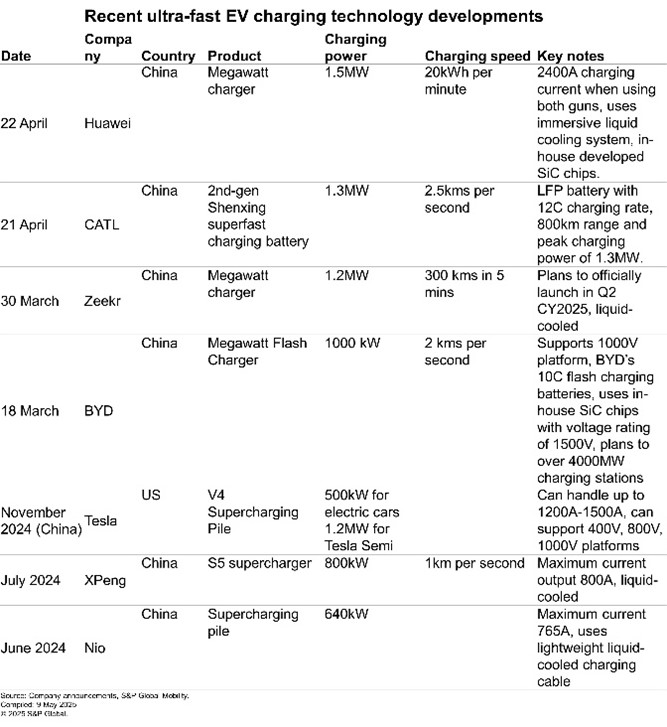
On March 17, China’s largest EV maker, BYD, launched an all-new Super e-Platform, which features flash-charging batteries, a 30,000 rpm electric motor, a new in-house designed silicon carbide (SiC) power chip, among other parts, to upgrade the core components in an EV to achieve a charging power of 1 megawatt (1000 kW) and a peak charging speed of 2 kms per second. The company said that its newly developed platform can deliver up to 400 kms of driving range within 5 minutes of charging time — the fastest charging mechanism available in mass produced vehicles. According to the company, the BYD Super e-Platform is the world’s first mass-produced 1000V high-voltage architecture for passenger vehicles.
This has come at a time when almost every other global automaker from the US, Europe, Japan, South Korea and other markets is still taking time to settle the 800V architectures in their respective portfolios. For example, Tesla mainly uses 400V architecture that supports charging EVs at up to 250 kW. That said, the newly launched Cybertruck (pickup) and Semi (electric truck) are developed on 800V and 1000V electrical platforms, respectively.
To achieve a faster flow of current inside the battery pack, BYD has reduced the internal resistance by 50% in its flash charging battery, achieving charging current of 1000A and charging rate of 10C. Notably, the C-rate is a measure of the speed at which a battery can be fully charged or discharged relative to its maximum capacity. While 1C would mean that a battery could be fully charged in 1 hour, 10C would mean that the battery can be fully charged in just 1/10th of an hour, which would be roughly 6 minutes. Therefore, the higher the C-rate, the faster a battery can be charged — a parameter equally important as a fast-charging pile.
According to BYD Chairman Wang Chuanfu, the development of the Super e-Platform is aimed at making the EV charging process as quick and as convenient as refueling a gasoline car.
At the China EV10 Forum 2025, which was organized in Beijing between March 28-30, Zeekr, Geely’s premium electric car unit, unveiled its plans to launch a fully liquid-cooled ultrafast charging pile that could deliver a peak power of 1.2MW per charging gun. The charging pile was later showcased at Auto Shanghai 2025 in April.
The 1.2MW ultrafast charger from Zeekr is the result of continuous advancement by its in-house team of engineers, upgrading the first-generation 360 kW fast charger to 600 kW and subsequently to 800 kW. That said, it remains unclear if Zeekr has developed EVs that could be compatible with its 1.2MW ultrafast charger, which is scheduled for an official launch in [mainland] China in second quarter 2025.
CATL organized its Super Tech Day on April 21, where it launched multiple advanced battery technologies, including the second generation of its Shenxing battery. The company said that it is the world’s first LFP battery, which features an 800 km range as well as a 12C peak charging rate — a significant advancement over the first generation 4C Shenxing battery launched in 2023.
The advanced version is also able to provide a peak charging power of 1.3 MW and achieves a range of 2.5 kms per second of charging.
A day later, on April 22, Huawei launched its megawatt fast-charging system that could deliver a peak power output of 1.5MW. Reportedly, Huawei’s MW charger, which was unveiled on the sidelines of 2025 Huawei DriveONE & Smart Charging Network Launch Conference in Shanghai, boasts of releasing a charging current of up to 2400A when using both the guns at the same time. At that rate, Huawei claims, its MW charger can charge a 300-kWh battery in about 15 minutes.
Reports suggest that while Huawei’s megawatt charger is aimed at heavy-duty electric trucks, Zeekr’s MW charger is developed for fast charging passenger EVs. That said, BYD is the only company that has officially used its 1MW charger to charge its passenger cars — Han L and Tang L models, which are developed on 1000V high-voltage architecture and use BYD’s 10C flash charging batteries.
Meanwhile, Huawei has conducted a pilot project deploying its megawatt charger at Shenzhen’s Yantian Port, where electric heavy-duty trucks have successfully implemented a “charge 15 minutes, operate 4 hours” work cycle. According to media reports, the project led to a 35% reduction in operating costs as compared to the traditional diesel engine powered trucks.
Il caricabatterie MW di Huawei è stato sviluppato utilizzando chip in carburo di silicio (SiC) di propria produzione — proprio come il caricabatterie MW di BYD — e impiega un sistema di raffreddamento a liquido immersivo per garantire un controllo efficiente della temperatura.
Perché le aziende cinesi stanno sviluppando tecnologie per la ricarica rapida dei veicoli elettrici
La crescente diffusione globale dei veicoli elettrici continuerà a stimolare nuove innovazioni nel campo delle tecnologie “grid-to-vehicle” (G2V) e “vehicle-to-grid” (V2G), con la Cina [continentale] — il più grande mercato mondiale dei veicoli elettrici — che dovrebbe superare tutti i paesi sviluppati. Continuando ad ampliare la propria infrastruttura di ricarica per veicoli elettrici fino a superare gli 11 milioni di stazioni di ricarica in tutto il Paese, la Cina [continentale] si sta ora preparando a compiere il prossimo passo verso la realizzazione di una vasta rete di stazioni di ricarica da megawatt.
A tal fine, BYD sta già lavorando alla creazione di una vasta rete di 4.000 stazioni di ricarica da 1 MW in tutta la Cina [continentale], con l’obiettivo di ridurre drasticamente i tempi di ricarica in questi siti. Mentre l’installazione di colonnine di ricarica superveloci e caricatori da megawatt costituisce un aspetto di questa strategia, aziende come Nio, CATL, Sinopec, Geely e altre stanno inoltre realizzando una vasta rete di sostituzione delle batterie per garantire tempi di ricarica rapidi presso queste strutture. L’obiettivo finale è dimostrare che l’esperienza dei consumatori nella ricarica dei propri veicoli elettrici presso una stazione di ricarica pubblica è ormai paragonabile a quella del rifornimento di un’auto a benzina.
Nel mercato ipercompetitivo della Cina [continentale], qualsiasi progresso tecnologico raggiunto da un marchio viene rapidamente superato dai rivali, a un ritmo che le case automobilistiche occidentali faticano a tenere. Di conseguenza, le prestazioni del Supercharger V4 di Tesla appaiono modeste se confrontate con i nuovi annunci relativi ai caricatori da megawatt.
Le aziende cinesi sono inoltre in grado di realizzare queste innovazioni grazie a una più lunga esperienza nella progettazione di architetture BEV ad alta tensione, alla padronanza della tecnologia SiC, ai sussidi governativi e a un ecosistema altamente favorevole.
Tuttavia, l’introduzione su larga scala dei caricatori da MW in tutto il Paese presenta molteplici sfide. Ad esempio, il funzionamento simultaneo di diversi Supercharger e caricatori da megawatt potrebbe creare un carico immenso sulla rete elettrica. Inoltre, l’ammodernamento della rete elettrica e della rete di ricarica esistente potrebbe rivelarsi un’operazione ad alto impiego di capitale. La mancanza di dati concreti sull’implementazione su larga scala dei caricatori da MW e sul loro impatto sulla rete rende l’implementazione ancora più ardua.
Detto questo, aziende come Huawei stanno già realizzando progetti pilota con i propri caricatori da MW che regolano dinamicamente la potenza in uscita per mitigare l’impatto sulle reti elettriche. Secondo quanto riferito, Huawei ha collaborato con la rete elettrica statale per sviluppare un sistema di programmazione intelligente in grado di gestire dinamicamente la potenza di ricarica e ridurre il carico di picco della rete fino al 40%.
Con collaborazioni così attive già in corso nella Cina [continentale], è altamente probabile che queste aziende forniranno molto presto aggiornamenti sulle prossime fasi di implementazione.
Uno sguardo al futuro
Se avete trovato questo articolo interessante, sappiate che sono aperte le iscrizioni al CWIEME Berlin 2026. Partecipate alla più grande fiera del settore dedicata all’avvolgimento di bobine e alla produzione di componenti elettrici per scoprire come i progressi nella tecnologia di ricarica dei veicoli elettrici stiano ridefinendo la mobilità elettrica e approfondire questi argomenti con colleghi, fornitori ed esperti del settore.
Autore
Amit Panday
Analista di ricerca senior, S&P Global Mobility
Per ulteriori informazioni, clicca qui.