.png?ext=.png)
Daha hızlı ve daha akıllı şarj teknolojisi yarışının, Çin’i elektrikli araç dünyasının bir sonraki büyük atılımının merkezine nasıl yerleştirdiği.
In [mainland] China's hypercompetitive market, any technological advancement achieved by one brand is quickly surpassed by rivals, a pace that Western global automakers find challenging to match.
The race to develop ultrafast chargers for electric cars started around 2022, when at an event, Chinese electric carmaker XPeng launched its S4 ultrafast supercharging technology. At the event in Guangzhou, the company organized a ‘live’ demonstration of charging its electric SUV G9 with its S4 supercharger, which delivered a Chinese light-duty test cycle (CLTC) range of 210 kms in just 5 minutes of charging.
It was then Xpeng Chairman and CEO He Xiaopeng took the spotlight and compared the performance of its S4 supercharging pile with Tesla’s then available V3 Supercharger and Porsche’s Turbo Supercharging pile.
While XPeng’s S4 supercharger boasted of a maximum power of 480 kW and a maximum current flow rate of 670A, Tesla V3 Superchargers and Porsche’s Turbo Supercharging pile delivered a maximum power of 250 kW (maximum current flow rate of 631A) and 350 kW (maximum current flow rate of 500A) respectively. Both Tesla and Porsche’s fast chargers could deliver shorter driving range in 5 minutes of charging time when compared to XPeng’s S4 supercharger.
Almost three years later, more companies from [mainland] China are stepping up to unveil their superfast charging solutions, all thanks to continuous enhancement of charging technologies with an aim of reducing the charging time.
It is known that while lack of adequate EV charging infrastructure continues to be the key roadblock in the global mass adoption of EVs, long charging durations, which also cause unavailability of public EV charging spaces, is emerging to be a strategic deterrent for people buying EVs.
High-power ultrafast chargers or supercharging piles are not the sole answer to this problem. While fast-charging EVs is key to significantly cutting down the charging times, to appropriately handle the high flow of current from the grid to the vehicle’s batteries, automakers have been lately developing dedicated 800V architectures, as against the more popular and affordable 400V platforms, comprising several components such as high-voltage battery pack, electric motors, inverters, onboard chargers, DC-DC converters and efficient thermal management systems.
The development of 800V architectures was first seen in [mainland] China, and the technology has been picked up by western automakers as well.
However, technology innovations in [mainland] China continues to move at a breakneck pace.
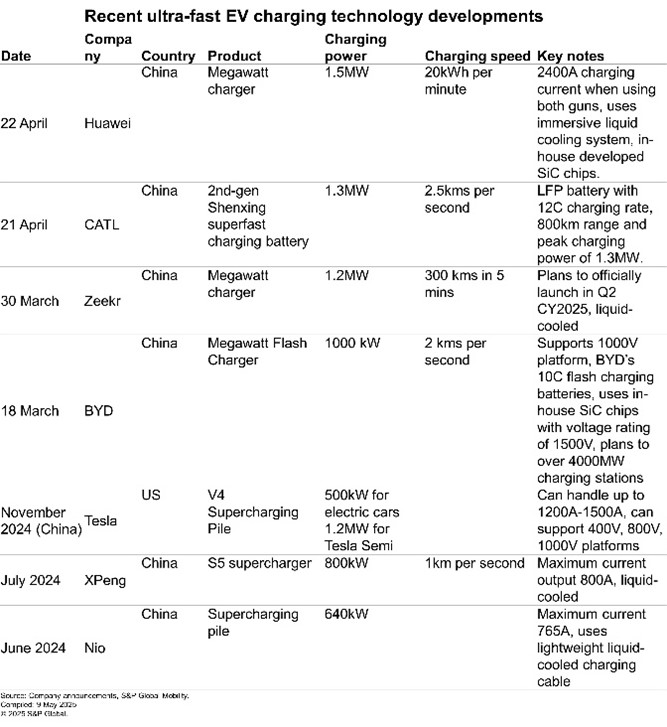
On March 17, China’s largest EV maker, BYD, launched an all-new Super e-Platform, which features flash-charging batteries, a 30,000 rpm electric motor, a new in-house designed silicon carbide (SiC) power chip, among other parts, to upgrade the core components in an EV to achieve a charging power of 1 megawatt (1000 kW) and a peak charging speed of 2 kms per second. The company said that its newly developed platform can deliver up to 400 kms of driving range within 5 minutes of charging time — the fastest charging mechanism available in mass produced vehicles. According to the company, the BYD Super e-Platform is the world’s first mass-produced 1000V high-voltage architecture for passenger vehicles.
This has come at a time when almost every other global automaker from the US, Europe, Japan, South Korea and other markets is still taking time to settle the 800V architectures in their respective portfolios. For example, Tesla mainly uses 400V architecture that supports charging EVs at up to 250 kW. That said, the newly launched Cybertruck (pickup) and Semi (electric truck) are developed on 800V and 1000V electrical platforms, respectively.
To achieve a faster flow of current inside the battery pack, BYD has reduced the internal resistance by 50% in its flash charging battery, achieving charging current of 1000A and charging rate of 10C. Notably, the C-rate is a measure of the speed at which a battery can be fully charged or discharged relative to its maximum capacity. While 1C would mean that a battery could be fully charged in 1 hour, 10C would mean that the battery can be fully charged in just 1/10th of an hour, which would be roughly 6 minutes. Therefore, the higher the C-rate, the faster a battery can be charged — a parameter equally important as a fast-charging pile.
According to BYD Chairman Wang Chuanfu, the development of the Super e-Platform is aimed at making the EV charging process as quick and as convenient as refueling a gasoline car.
At the China EV10 Forum 2025, which was organized in Beijing between March 28-30, Zeekr, Geely’s premium electric car unit, unveiled its plans to launch a fully liquid-cooled ultrafast charging pile that could deliver a peak power of 1.2MW per charging gun. The charging pile was later showcased at Auto Shanghai 2025 in April.
The 1.2MW ultrafast charger from Zeekr is the result of continuous advancement by its in-house team of engineers, upgrading the first-generation 360 kW fast charger to 600 kW and subsequently to 800 kW. That said, it remains unclear if Zeekr has developed EVs that could be compatible with its 1.2MW ultrafast charger, which is scheduled for an official launch in [mainland] China in second quarter 2025.
CATL organized its Super Tech Day on April 21, where it launched multiple advanced battery technologies, including the second generation of its Shenxing battery. The company said that it is the world’s first LFP battery, which features an 800 km range as well as a 12C peak charging rate — a significant advancement over the first generation 4C Shenxing battery launched in 2023.
The advanced version is also able to provide a peak charging power of 1.3 MW and achieves a range of 2.5 kms per second of charging.
A day later, on April 22, Huawei launched its megawatt fast-charging system that could deliver a peak power output of 1.5MW. Reportedly, Huawei’s MW charger, which was unveiled on the sidelines of 2025 Huawei DriveONE & Smart Charging Network Launch Conference in Shanghai, boasts of releasing a charging current of up to 2400A when using both the guns at the same time. At that rate, Huawei claims, its MW charger can charge a 300-kWh battery in about 15 minutes.
Reports suggest that while Huawei’s megawatt charger is aimed at heavy-duty electric trucks, Zeekr’s MW charger is developed for fast charging passenger EVs. That said, BYD is the only company that has officially used its 1MW charger to charge its passenger cars — Han L and Tang L models, which are developed on 1000V high-voltage architecture and use BYD’s 10C flash charging batteries.
Meanwhile, Huawei has conducted a pilot project deploying its megawatt charger at Shenzhen’s Yantian Port, where electric heavy-duty trucks have successfully implemented a “charge 15 minutes, operate 4 hours” work cycle. According to media reports, the project led to a 35% reduction in operating costs as compared to the traditional diesel engine powered trucks.
Huawei’nin MW şarj cihazı, BYD’nin MW şarj cihazında olduğu gibi, şirketin kendi geliştirdiği silikon karbür (SiC) yongaları kullanılarak tasarlanmıştır ve ısıyı verimli bir şekilde kontrol altında tutmak için kapsamlı bir sıvı soğutma sistemi kullanmaktadır.
Çinli Şirketler Neden Hızlı Elektrikli Araç Şarj Teknolojisi Geliştiriyor?
Dünya çapında elektrikli araçların yaygınlığının artması, şebekeden araca (G2V) ve araçtan şebekeye (V2G) teknolojileri alanında yeni yenilikleri tetiklemeye devam edecek; dünyanın en büyük elektrikli araç pazarı olan [anakara] Çin’in ise tüm gelişmiş ülkeleri geride bırakması bekleniyor. Ülke genelinde elektrikli araç şarj altyapısını 11 milyondan fazla şarj istasyonuna genişletmeye devam eden [anakara] Çin, şimdi de megavatlık şarj istasyonlarından oluşan geniş bir ağ kurarak bir sonraki adımı atmaya hazırlanıyor.
Bu amaçla BYD, [anakara] Çin genelinde 4000 adet 1 MW'lık şarj istasyonundan oluşan geniş bir ağ kurmak için şimdiden çalışmalara başlamış durumda ve bu istasyonlarda şarj sürelerini önemli ölçüde kısaltmayı hedefliyor. Süper şarj istasyonları ve megavatlık şarj cihazlarının kurulumu bu yaklaşımın bir parçasını oluştururken, Nio, CATL, Sinopec, Geely ve diğerleri gibi şirketler de bu şarj tesislerinde hızlı hizmet süresi sağlamak için geniş bir pil değiştirme ağı kuruyor. Nihai amaç, tüketicilerin elektrikli araçlarını halka açık şarj istasyonlarında şarj etme deneyiminin artık benzinli bir araca yakıt ikmali yapma deneyimiyle aynı seviyede olduğunu kanıtlamaktır.
Çin [anakarasındaki] aşırı rekabetçi pazarda, bir markanın elde ettiği herhangi bir teknolojik ilerleme rakipler tarafından hızla geride bırakılıyor; bu hız, Batılı küresel otomobil üreticilerinin ayak uydurmakta zorlandığı bir tempo. Sonuç olarak, Tesla’nın V4 Süper Şarj Cihazı istatistikleri, yeni megavatlık şarj cihazı duyurularıyla karşılaştırıldığında mütevazı kalıyor.
Çinli şirketler, yüksek gerilimli BEV mimarileriyle uzun süredir çalışmış olmaları, SiC teknolojisindeki uzmanlıkları, devlet sübvansiyonları ve son derece elverişli bir ekosistem sayesinde bu yenilikleri hayata geçirebiliyorlar.
Ancak, ülke genelinde MW şarj cihazlarının büyük ölçekli olarak yaygınlaştırılması önünde birçok zorluk bulunmaktadır. Örneğin, birkaç süper şarj cihazı ve megavatlık şarj cihazının aynı anda çalışması, elektrik şebekesi üzerinde çok büyük bir yük oluşturabilir. Ayrıca, elektrik şebekesinin yanı sıra mevcut şarj ağının da iyileştirilmesi, oldukça sermaye yoğun bir çalışma olabilir. MW şarj cihazlarının büyük ölçekli yaygınlaştırılmasına ve bunun şebekeye etkisine dair gerçek dünya verilerinin eksikliği, bu uygulamanın gerçekleştirilmesini daha da zorlu hale getiriyor.
Bununla birlikte, Huawei gibi şirketler, elektrik şebekeleri üzerindeki etkiyi azaltmak için çıkış gücünü dinamik olarak ayarlayan MW şarj cihazlarıyla halihazırda pilot projeler yürütüyor. Bildirildiğine göre Huawei, şarj gücünü dinamik olarak yönetmek ve şebekenin en yüksek yükünü %40’a kadar azaltmak amacıyla akıllı bir planlama sistemi geliştirmek üzere devlet şebekesi ile işbirliği yapmıştır.
[Çin anakarasında] bu tür aktif işbirlikleri halihazırda devam etmekte olduğundan, bu şirketlerin çok yakında bir sonraki kurulum adımları hakkında bilgi vermesi oldukça muhtemeldir.
Geleceğe bakış
Bu makaleyi bilgilendirici bulduysanız, CWIEME Berlin 2026 için kayıtlar artık başlamıştır. Sektörün en büyük bobin sarma ve elektrikli üretim fuarına katılarak, elektrikli araç şarj teknolojisindeki gelişmelerin e-mobiliteyi nasıl yeniden şekillendirdiğini keşfedin ve bu konuları meslektaşlarınız, tedarikçileriniz ve teknik liderlerle daha derinlemesine tartışın.
Yazar
Amit Panday
Kıdemli Araştırma Analisti, S&P Global Mobility
Daha fazla bilgi için lütfen buraya tıklayın.