.png?ext=.png)
Global transformer demand is driving a new investment cycle, where capacity, lead times and regional manufacturing strategies are now critical to keeping grid projects on track.
The global transformer industry has entered a decisive investment cycle, driven by an unprecedented convergence of electrification, renewable energy expansion, aging grid replacement, industrial reshoring in developed markets, nearshoring in regional supply chains, and rising power demand from digital infrastructure.
What was once considered a stable and cyclical industrial segment has now become one of the most strategically important supply chains in the power sector. Across utilities, governments, EPC contractors, and industrial customers, transformers have become a gating factor for project execution.
The current boom is not simply a story of rising demand. It is a story of structural undersupply in some segments, regional overdependence in others, and a rapidly evolving manufacturing footprint. Large power transformers, small and medium power transformers, and distribution transformers are all seeing strong growth, but the severity of shortages, lead times, and investment intensity varies materially by category and geography.
From large power transformers to distribution technologies, discover the companies driving innovation across every segment at CWIEME Berlin.
Secure your visitor passGlobal Market Overview: A Three Tier Transformer Upswing
At the global level, the large power transformer (LPT) market remains the most constrained segment. These transformers are essential for transmission networks, utility substations, renewable evacuation corridors, HVDC links, and industrial mega projects. Global utilization rates are already near 70% and are expected to move toward 80% by 2030, indicating a structurally tight market. In mature markets such as North America and Europe, lead times have stretched to 4 to 7 years, while even Asian exporters are increasingly booked into 2028 and beyond.
The reason is straightforward: LPT manufacturing is difficult to scale quickly. It requires specialized engineering talent, long production cycles, advanced testing infrastructure, and reliance on global network for critical components such as bushings, tap changers, and grain oriented electrical steel. This has made new capacity additions highly strategic and concentrated among a limited number of global players.
The small and medium power transformer (SMPT) segment is comparatively less constrained today, but demand momentum is building rapidly. This category supports renewables integration, industrial power systems, urban substations, and commercial infrastructure. Global utilization currently remains around 55%, rising toward 65% by 2030. While there is more installed capacity in this segment, much of it sits in Asia, meaning regional bottlenecks can still emerge in Europe and North America where demand growth is strongest.
Distribution transformers (DTRs), meanwhile, represent the highest volume opportunity globally. These products sit closest to end consumers and are required for housing growth, EV charging, rooftop solar, commercial buildings, and local grid reinforcement. Utilities in several markets have already faced shortages in pad mounted and pole mounted units. While manufacturing is less complex than LPTs, demand is broad based and recurring, making DTRs one of the most attractive medium term growth segments.
Global Large Power Transformers Annual Market Outlook:
Based on emerging market trends, a sustained structural deficit in Large Power Transformer (LPT) production capacity is projected, with North America (NAM) and the Middle East & Africa (MEA) acting as primary demand hubs. As, and if, demand continues to outpace supply in these key regions, manufacturing facilities are expected to operate at significantly higher utilization rates to bridge the gap through at least 2030. Owing to abundant production with lower lead times, there is a clear opening for APAC suppliers to invest in European and North American compliance and certification regimes. By doing so, they can position themselves as reliable, certified partners for under supplied markets and capture share where local supply remains constrained.
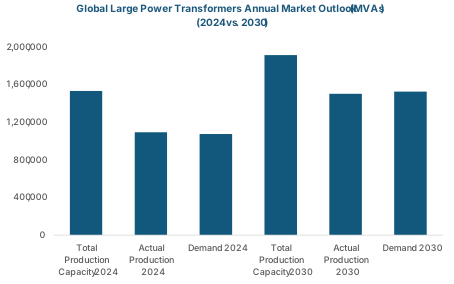
Figure 1: Global Large Power Transformers Annual Market Outlook (MVAs) (2024 vs. 2030)
Source: PTR Inc.
Global Small to Medium Power Transformers Annual Market Outlook:
Global demand for small power transformers is expected to grow at nearly 6% CAGR from 2024 to 2030, while capacity will rise more slowly at around 2% CAGR, indicating a gradually tightening market. Lead times are still under one year today, but stronger renewable demand in Europe and North America could stretch them further.
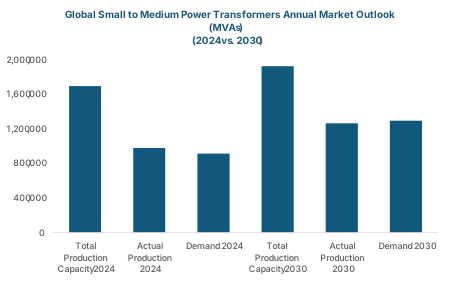
Figure 2: Global Small to Medium Power Transformers Annual Market Outlook (MVAs) (2024 vs. 2030)
Source: PTR Inc.
Global Distribution Transformers (DTRs) Annual Market Outlook:
The global distribution transformer market is set to rise from USD 23.7 billion in 2024 to USD 34.3 billion by 2030, growing at a 6.3% CAGR. Demand remains heavily concentrated in utilities and power generation, which together account for 79% of global demand, supported by grid modernization, renewable integration, and aging asset replacement, while data centers are emerging as a faster growing segment, expected to reach 9% share by 2030. Competitive dynamics are also shifting, as Chinese and Turkish suppliers gain ground through cost advantage and faster delivery, especially in Europe’s price sensitive segments, while lead time, local manufacturing, and application specific technology choices continue to shape procurement decisions across regions.
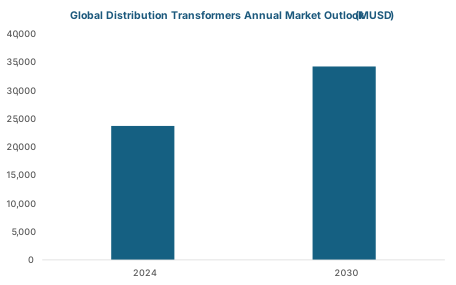
Figure 3: Global Distribution Transformers Annual Market Outlook (MUSD)
Source: PTR Inc.
Where the Market Is Tightest: A Global Supply Demand Reality Check
The most undersupplied transformer markets today are North America and MEA (Middle East Africa), particularly in power transformers. Both regions have seen demand accelerate faster than local manufacturing capacity can expand. By contrast, Asia Pacific remains the most balanced region structurally because it houses the largest manufacturing base. Europe remains one of the strongest manufacturing bases for high value LPTs and exports heavily into North America and the Middle East while South America sits between local sufficiency and export opportunity.
This divergence explains why the current investment cycle is not uniform. Some regions are building to meet domestic shortages. Others are expanding to become export hubs. Several are responding to localization mandates rather than pure economics.
What emerges from the data is clear: the transformer investment boom is real, but it is highly selective.
Connect with global manufacturers and solution providers addressing transformer shortages and long lead times.
Join the industry in BerlinAsia Pacific: The World’s Production Engine
Asia Pacific remains the backbone of global transformer manufacturing and the largest source of incremental capacity through 2030. The region’s large power transformer (LPT) manufacturing capacity is projected to grow at a CAGR of approximately 3.1% between 2024 and 2030, while small and medium power transformer (SMPT) capacity is expected to expand at a CAGR of around 1.9% over the same period.
China dominates the regional landscape, accounting for the majority of installed manufacturing capacity and serving both domestic and export markets. Its production growth in recent years has been strong, and Chinese manufacturers are well positioned to capture international share while Western markets remain undersupplied.
India is the second major growth engine. Supported by domestic grid investment and competitive manufacturing economics, India is scaling quickly across both power and distribution transformers. New investments from Hitachi Energy, CG Power, Siemens Energy India, Voltamp, and Toshiba indicate that India is becoming not only a domestic supply market but also an export platform.
South Korea remains strategically important in premium high voltage exports. Hyundai Electric, Hyosung, and LS Electric have reached very high utilization levels and are expanding aggressively to meet North American demand.
In the region, the distribution transformer market is expanding steadily at a 7% CAGR, fueled by grid upgrades, renewable energy integration, and data center growth across key markets. Utilities anchor demand through ongoing reinforcement of MV/LV networks and reliability focused replacements, while high growth areas like data centers, wind, BESS, and solar drive needs for efficient, high-MVA units particularly in China's renewables push and Malaysia's digital infrastructure. Australia leads with the strongest CAGR, supported by a 53 GW renewables and storage pipeline in the National Electricity Market and USD 6.7 billion in data center investments in 2024, doubling capacity from 1,350 MW to 3,100 MW by 2030.
Capacity additions are extensive. Hitachi Energy is investing USD 250 million in India to expand large power transformer manufacturing. CG Power is investing USD 82 million in a new facility due by 2028. Hyosung Heavy Industries is investing USD 238 million in Changwon. HD Hyundai Electric is expanding 765 kV production in Ulsan. LS Electric is scaling Busan and Ulsan facilities. Toshiba plans to more than double capacity through investments across Japan and India.
For distribution transformers, Toshiba is investing around USD 63 million in India, CG Power is expanding Bhopal from 6,900 MVA to 9,900 MVA annually, and JST Power is opening a Malaysia facility for 25 kVA to 6,000 kVA pad mounted units.
Asia Pacific is therefore not the most undersupplied region, but it is the region solving undersupply elsewhere.
North America: The Most Critically Undersupplied Market
North America is currently the tightest transformer market globally, especially for power transformers. Regional production capacity of power transformers stands at only around 200,000 MVAs as of mid 20s, insufficient for current and future grid needs. Demand is being driven by aging infrastructure replacement, renewable interconnections, data centers, industrial reshoring, and electrification.
For distribution transformers, demand is being driven by feeder upgrades, EV charging, data centers, undergrounding programs, and renewables. U.S. dry type distribution transformer demand is projected to grow at a CAGR of approximately 3.7% between 2024 and 2030. Oil filled pad mounted units are also expanding rapidly as utilities shift away from exposed pole mounted assets in climate risk zones.
Lead times of six to seven years for large power transformers are now common, with some deliveries extending into the next decade. Domestic factories are already operating near maximum utilization, and imports continue to play a critical balancing role.
This is why North America is seeing one of the most aggressive investment pipelines globally. Hitachi Energy is investing USD 457 million in a new Virginia power transformer facility. Prolec GE is investing USD 140 million in North Carolina to add around 200 units annually. Delta Star is expanding Virginia operations with USD 35 million focused on units up to 200 MVA. Hyundai Power Transformers is increasing 765 kV output by 50 percent. WEG is building a Mexico plant for 250 MVA to 600 MVA power transformers.
On the distribution side, Eaton, ERMCO, Central Moloney, Virginia Transformers, Hammond Power Solutions, JST Power Equipment, and Hitachi Energy are all expanding U.S. and Mexican capacity.
Even after these expansions, North America is likely to remain structurally undersupplied through much of the decade, making it one of the most attractive markets for future investment.
Europe: Premium Manufacturing Hub for Grid Transition
Europe combines mature replacement demand with aggressive decarbonization investment, making it one of the most attractive transformer markets globally. Europe’s large transformer lead times remain stretched at 4 to 5 years and small to medium units at 8 to12 months, underscoring persistent supply pressure despite a strong production base.
For power transformers, Europe remains a global center for high specification manufacturing and export. Large power transformer capacity is projected to grow at a CAGR of approximately 3.3% between 2024 and 2030, while small to medium power transformer capacity is expected to expand at a CAGR of around 3.8% over the same period. Demand is driven by offshore wind connections, cross border interconnectors, HVDC corridors, industrial electrification, and replacement of aging transmission assets.
For distribution transformers, Europe is also strong, especially dry type products used in buildings, tunnels, metros, and data centers. Europe’s dry type transformer market is projected to grow at a CAGR of approximately 8.1% between 2024 and 2030. Rising dry type distribution transformer demand is driven by urban substations and fast growing data centers, where fire safety, compact design, and compliance with IEC standards are increasingly important. Europe is also a net supplier of dry type distribution transformers, exporting about twice as much as it imports, with Germany and Italy leading exports and the United States, the UAE, and Mexico as key destinations; at the same time, imported units from China, South Korea, and India continue to support mid tier and commodity demand.
In oil filled distribution transformers, demand is projected to grow at a CAGR of approximately 7.7% from 2025 to 2030, while production is expected to remain modestly above demand and capacity expansion should keep utilization in the 75 to 80% range, indicating a broadly balanced market with available headroom. for growth, export opportunities, and resilience against supply disruptions.
The region is also seeing major investment from leading players, including Hitachi Energy’s $1.5 billion global capacity expansion program, as well as investments for capacity additions from KPT, Kolektor Etra, Faramax Trafo, and R&S Transformers.
Overall, Europe is likely to remain a strategically important supplier base, especially as more than 75% of planned large transformer capacity additions and more than half of small to medium investments are already backed by announced commitments, but its competitive position will increasingly depend on execution, quality, certification, and delivery reliability rather than just installed capacity.
Middle East & Africa: Demand Growth Meets Localization
The Middle East and Africa transformer market is witnessing increasing localization supported by utility expansion, grid development, and industrial diversification.
In Saudi Arabia, Saudi Power Transformer Company (SPTC) is investing over USD 51 million to expand power transformer capacity by 2027, while Bawan Company is developing a new high voltage transformer plant expected to be completed by 2027. Several Chinese OEMs, including TBEA, LEEC, and Chint Transformer, are also evaluating manufacturing investments in the Kingdom.
In Africa, Elsewedy Electric has expanded its industrial footprint with a new power transformer facility in Tanzania expanding its capacity to 2,5000 units/year. ACTOM has established a new distribution transformer facility in South Africa, and Tanelec Ltd. has invested USD 15 million to expand production capacity in Tanzania. Additionally, ZESA Enterprises is scaling transformer output in Zimbabwe, while KenGen is planning a new transformer manufacturing facility in Kenya.
South America: The Quiet Manufacturing Opportunity
South America is often overlooked, but it is becoming increasingly relevant. South America is gradually developing transformer manufacturing capacity, led by Brazil, Colombia, and Argentina. The region is benefiting from grid expansion programs such as Brazil’s PDE 2034 plan, which includes 30,000 kilometers of transmission lines and 82,000 MVA of substation capacity additions.
WEG is a dominant regional player, investing over 206 million dollars in Brazil for transformer capacity expansion and establishing new production facilities in Colombia. Hitachi Energy is expanding manufacturing capacity in Brazil and Colombia to support growing utility and renewable demand. Rymel is constructing new manufacturing plants in Colombia to support domestic distribution transformer requirements, while Argentina is expanding capacity through Tubos Trans Electric, increasing production from 1920 MVA to 4000 MVA.
The region benefits from competitive costs, skilled labor, and growing export relevance. This makes the region strategically interesting: it can serve as both a local market and an alternative global supply base.
Join expert-led sessions and networking opportunities to prepare for the next phase of transformer market growth.
Attend CWIEMEWhat Happens Next
Three themes are likely to define the transformer market through 2030.
First, large power transformers will remain the most supply constrained category globally, with new capacity additions helping but not fully eliminating shortages.
Second, distribution transformers may become the most commercially important volume segment owing to digitalization and electrification of households, cities, and transport systems.
Third, manufacturing footprints will continue regionalizing. Utilities increasingly want local or proximate supply, and governments are treating transformers as strategic infrastructure.
The Bottom Line
The global transformer boom is real, but it is uneven. Asia Pacific is adding scale. North America is chasing supply security. Europe is expanding to defend resilience. The Middle East is localizing production. South America is emerging as a flexible export platform.
For industry leaders, the key takeaway is simple: this is no longer just an equipment market. It is now a strategic capacity market, where location, lead time, and manufacturing footprint matter as much as price.
About the Author:
.jpg)
Saifa Khalid
Director Research – EMEAPAC
Saifa is a senior analyst at PTR Inc. Her main area of interest is power systems. Currently, she leads the power grid research team in developing PTR’s syndicated power grid services and manages custom research projects for Fortune 500 clients globally. Her mandate covers HV switchgear, MV switchgear, power transformers, distribution transformers, substation automation, and power factor correction, etc. Saifa comes from a technical background and has a BSc. degree in Electrical Engineering.
About PTR:
With over a decade of experience in the Power Grid and New Energy sectors, PTR Inc. has evolved from a core market research firm into a comprehensive Strategic Growth Partner, empowering clients’ transitions and growth in the energy landscape and E-mobility, particularly within the electrical infrastructure manufacturing space.