.png?ext=.png)
CES 2026 confirmed that software-defined vehicles have moved into full industrialisation, with OEMs and technology leaders executing scalable, AI-driven platforms designed for mass production, lifecycle management and continuous over-the-air evolution.
AI is becoming both a vehicle capability and a manufacturing tool for software. CES 2026 confirmed that SDVs are no longer experimental and that the industry is now executing repeatable, AI-driven, virtualized software platforms designed for mass production, long life-cycle support and continuous OTA evolution.
The recently concluded Consumer Electronics Show (CES) 2026 (Jan. 6–9, 2026) marked a clear inflection point: software-defined vehicles (SDVs) have entered their industrialization phase. Original equipment manufacturers and suppliers shifted decisively away from exploratory demos and concepts toward scalable, production-ready SDV platforms, with most architectures, toolchains and compute strategies aligned to 2026–28 SOPs. The focus has clearly moved from what SDVs could do, to how they can be built, validated, operated and monetized at scale.
See SDV Industrialisation in Action at CWIEME Berlin 2026
CES 2026 showed that software-defined vehicles are scaling fast. At CWIEME Berlin, discover the hardware, components and engineering innovations making this transformation possible — from advanced E/E architectures to next-generation manufacturing solutions.
Register for Your Free CWIEME Berlin Ticket
Across all demos, software scalability, reuse and life-cycle management replaced feature novelty as the dominant theme. Cybersecurity and functional safety were treated as architectural constraints, embedded from silicon through middleware and virtual validation, rather than addressed post-integration.
Major SDV showcases
Companies such as QNX demonstrated advanced vehicle software platforms, including cloud-first digital cockpits and modular software stacks for SDV development, aimed at reducing integration effort and accelerating innovation for OEMs. Among the highlights was the Alloy Kore Foundational Vehicle Software Platform that combines QNX's safety-certified operating system and virtualization with Vector's safe middleware. At the core of Alloy Kore is the QNX OS for Safety or the QNX Hypervisor for Safety 8.0, supplemented by certified runtime environments. Select OEMs including Mercedes-Benz are already exploring how to integrate Alloy Kore into their next-generation SDV architectures.
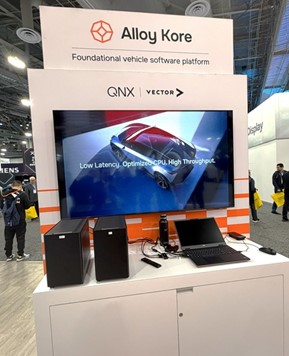
QNX Alloy Kore
Source: S&P Global Mobility
Qualcomm emerged as a central enabler, positioning its Snapdragon platforms as the foundation for real-time, agentic vehicle intelligence — automotive AI systems that can act independently based on context — supporting scalable autonomy from Level 1 to Level 3 without locking manufacturers into proprietary architectures. Also noteworthy was Qualcomm’s Letter of Intent to supply future Volkswagen (VW) and Rivian vehicles (from 2027) with powerful in-vehicle infotainment chips that can scale to support autonomy for the high-volume SSP platform outside mainland China. Qualcomm also discussed its deal with Leapmotor to provide cockpit and Ride Elite system-on-chips (SoCs) — for example, the Qualcomm SA8797P — to enable cross-domain compute convergence. Leapmotor already uses Qualcomm for cockpits and has one of the most efficient zone electronic control units (ECUs) and central compute designs in the market, with impressive ECU reduction statistics.
Aumovio offered a vehicle control high-performance computer for safety-critical and non-safety-critical functions. While much attention is rightly given to the development of compute for data-hungry infotainment and driver-assist applications, vehicle management at real-time speeds with a high functional safety rating is the next major integration “brick” in the electrical/electronic (E/E) consolidation road map.
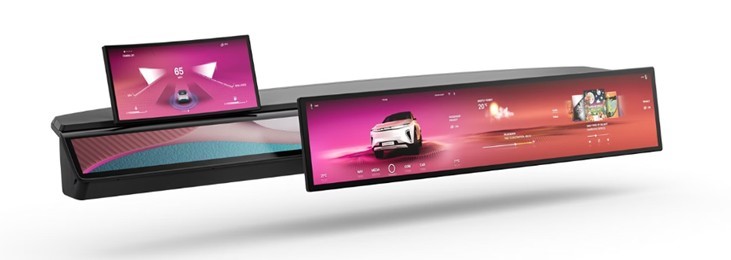
Aumovio-branded personalized cockpit
Source: S&P Global Mobility
Bosch highlighted AI-driven cockpit systems, motion control and by-wire technologies — systems that replace mechanical connections with electronic controls — signaling growing separation between hardware and software layers.
Foxconn unveiled offerings that positioned it as an SDV manufacturing and compute platform enabler. Foxconn is gaining relevance as a contract manufacturer of central computers, underscoring an increasingly popular trend among OEMs to develop key SDV hardware in-house and outsource manufacturing to build-to-print players rather than leave full development to tier 1 suppliers.
Elektrobit showcased modular, Linux-based SDV platforms and integration-as-code frameworks alongside Foxconn EV hardware, aimed at shortening development cycles and enabling platform reuse across models.
KPIT Technologies demonstrated its Mobility Agentic AI solution suite; a modular, cloud-ready ecosystem designed to address the full complexity of modern automotive software development. It leverages generative AI and integrates with Microsoft Foundry, enabling robust model orchestration, evaluation and policy-driven guardrails.
ThunderSoft demonstrated AquaDrive OS 2.0 Pre, an AI-native vehicle operating system designed to accelerate the industry’s transition toward AI-defined vehicles. ThunderSoft is reportedly working with multiple ecosystem partners, including AISpeech, HERE, Dirac, ETAS, ModelBest, Qwen and Volcengine, to broaden AquaDrive OS 2.0 Pre use cases.
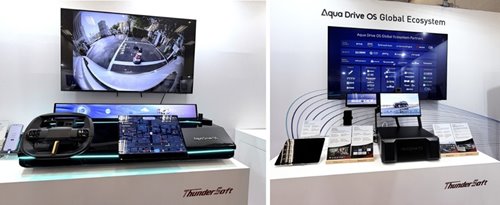
ThunderSoft AquaDrive OS 2.0 Pre demonstration
Source: S&P Global Mobility
TomTom said its AI-powered Orbis Maps would be integrated into VW’s CARIAD software stack, supporting safety-critical functions and more humanlike driving behavior.
Semiconductor and software partnerships (e.g., Qualcomm with Hyundai Mobis) showed unified compute solutions that integrate cockpit, advanced driver assistance systems and connectivity, pushing toward centralized, high-performance SDV systems.
Mainland Chinese developer of E/E architecture solutions, Autolink, showed its PCIe-based fiber-optic bus connection as the next generation of high-bandwidth solutions for highly automated vehicles. Several mainland Chinese OEMs are developing such bus networks that are perceived as a viable solution to total vehicle bandwidth of over 200 Gbps at higher autonomy levels, i.e., beyond Level 3. Autolink's solution supports connections over 64 Gbps and optical fiber is only one-fifth the weight of copper. Costs with excessive shielding become an issue at these high data rates, posing challenges for Ethernet, which currently dominates designs at 10 Gbps and below.
Additionally, Autolink and Tata Elxsi signed memoranda of understanding (MOUs) aimed at accelerating SDV adoption among global OEMs, highlighting growing industry collaboration.
Automotive players such as BMW and Mercedes-Benz showcased AI-driven assistants, infotainment upgrades and SDV strategies as part of their broader digital transformation.
Sonatus used a 2026 Nissan Leaf to demonstrate how AI tools can accelerate vehicle development, helping Nissan Technical Centre Europe (NTCE) to deliver faster, smarter and more efficient engineering workflows.
Advanced SoCs and automotive processors were front and center, with major chipmakers introducing hardware tailored for vehicles that support AI processing, ADAS, infotainment and connectivity.
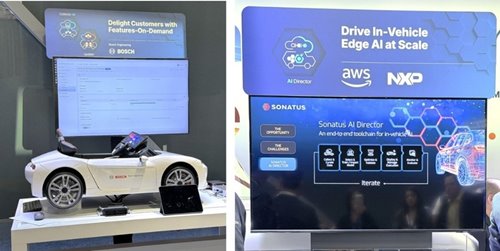
Sonatus booth
Source: S&P Global Mobility
Visteon and Autolink demonstrated HPC-centric E/E architectures that consolidate up to nine ECUs into a single compute node, targeting aggressive cost points while maintaining modularity across zones and vehicle segments. These architectures are reportedly already being assessed in projects by Geely and Chery.
Texas Instruments unveiled new high-performance automotive SoC families capable of delivering up to 1,200 trillion operations per second (TOPS), boosting onboard AI compute for safety and autonomy functions. These chips also help to integrate radar and Ethernet networking directly into next-generation vehicle platforms.
Infineon and partners introduced development tools such as zone controller kits for SDVs to accelerate E/E architecture design across multiple segments.
Samsung Semiconductor’s Detachable AutoSSD received a CES Innovation Award, representing the move toward modular, high-performance auto storage catering to data-rich, software-driven vehicle systems.
Electronics architecture innovation
Next-generation E/E architectures were a core theme, as the industry moves from distributed ECUs to centralized compute and zonal systems.
Explore the Future of E/E Architecture Live
From centralized compute to zonal systems, the shift in vehicle architecture is accelerating. Meet the engineers, suppliers and innovators driving electrification and system integration at CWIEME Berlin 2026
Secure your free pass
Autolink and ReinOCS announced a partnership focused on a Deep Fusion EEA (Electronic/Electrical Architecture) that combines centralized computing with high-bandwidth optical communication, aimed at addressing data bottlenecks and supporting future autonomy (Level 4+) and high-sensor applications.
Several collaborations, such as between Infineon and HL Klemove, targeted next-generation zonal control units, vehicle Ethernet backbones and radar subsystems; core elements of scalable SDV architectures.
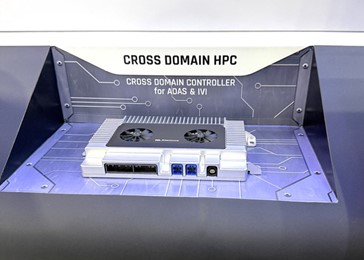
HL Klemove cross-domain HPC
Source: S&P Global Mobility
Software and security platforms were also highlighted. Companies such as SYSGO demonstrated high-assurance automotive software that can run multiple real-time environments safely on shared hardware — an important foundation for modern SDVs.
Broader trends and context
Across the show, agentic AI integration was the dominant narrative, linking semiconductor innovation directly with automotive software, autonomous driving and digital cockpit experiences. Automotive agents were presented as part of broader ecosystems that link vehicle systems with cloud services, apps and customer service workflows; for example, handing off interactions between car and dealer support.
AI assistants for coding, testing and validation are now becoming standard components of SDV toolchains. Aptiv highlighted long-term infotainment and user experience (UX) upgrade cycles extending to 15 years, enabled by centralized compute and over-the-air (OTA) strategies, while continuing selective reliance on dedicated ECUs for latency-critical functions such as surround view.
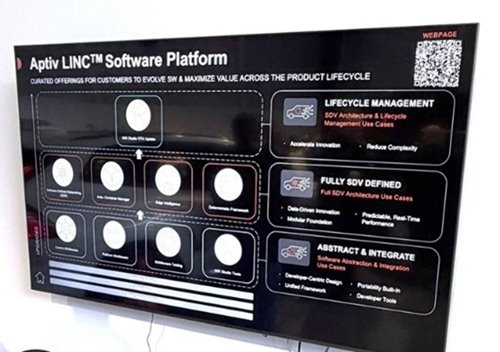
Source: S&P Global Mobility
Demonstrations showed vehicles responding like “smart companions” that adapt to occupants’ preferences, moods and even real-time conditions, such as by adjusting music or suggesting routes based on familiarity or emotional cues.
Automotive displays and occupant experience technologies, such as LG’s AI Cabin Platform using GenAI for immersive in-vehicle interactions, underscored how electronics and architecture are evolving beyond traditional powertrain and safety functions.
Sensor advancements — including high-resolution radar and microelectromechanical sensors (MEMS) devices — also signaled a move toward richer perception stacks essential for autonomy and ADAS.
Crucially, CES confirmed that AI, machine learning and advanced automation are not limited to end-user vehicle features, such as AI assistants, enhanced navigation or immersive cockpits. Instead, AI is becoming embedded across the entire SDV life cycle, deeply transforming development and platform management. Multiple players demonstrated AI-driven automation of software-in-the-loop (SIL), hardware-in-the-loop (HIL), model-in-loop (MIL) and virtual validation, where requirements for generation, test creation, regression testing, anomaly detection and performance optimization are increasingly machine-driven rather than engineer-led.
Where AI Meets Electrification
AI is reshaping the entire vehicle lifecycle — from development to validation to production. Continue the conversation at CWIEME Berlin 2026 and gain practical insights into how electrification and digitalisation are converging.
Join the industryCerence AI showcased xUI, its new human-machine interface (HMI) platform that combines hybrid, agentic intelligence with production-ready NVIDIA software and services running on Microsoft Azure. The platform enables intent-aware, natural dialogue, allowing drivers and passengers to speak freely without the frustration of unrecognized requests. It also enables in-car assistants to respond to a far wider range of tasks, delivering precise, conversational answers that fit real-world needs thanks to multi-intent understanding. For example, “Roll down the windows and then find me a coffee shop with great reviews, free Wi-Fi and on-site parking.”
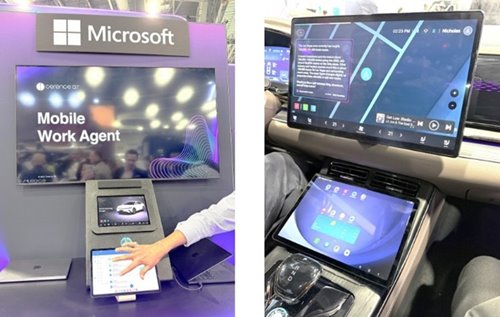
Cerence xUI platform
Source: S&P Global Mobility
SoundHound AI exhibited its in-vehicle voice-based agentic AI ordering platform.
Companies showcased AI stacks designed to handle perception, planning and control for advanced autonomy (Level 4+), underlining how agentic logic can power autonomous driving behavior. Participants emphasized moving toward software-centric vehicles in which onboard agents manage updates, diagnostics and adaptive driving features as part of broader SDV initiatives.
Key takeaways
CES 2026 marked a clear shift in the automotive industry’s priorities. The event reinforced that software is rapidly becoming the defining element of next-generation vehicles, with ecosystems evolving around cloud services, AI, connectivity and modular software platforms that enable continuous updates, differentiated user experiences and advanced automation.
CES 2026 confirmed that SDVs are no longer experimental. The industry is now executing on repeatable, AI-driven, virtualized software platforms designed for mass production, long life-cycle support and continuous OTA evolution. AI has become both a vehicle capability and a manufacturing tool for software itself, fundamentally reducing human-intensive engineering and enabling OEMs to operate at SDV scale from 2026–28 and beyond.
CES also exposed the economic reality of SDV industrialization, including dynamic RAM (DRAM) price inflation expected in 2026, reinforcing pressure on OEMs to justify high-performance silicon through tangible software value and reuse across vehicle lines. As OEMs are pressed to reduce the cost of new hardware to support SDV designs, they are proactively looking to reduce the number of ECUs and standardize more hardware, while benefiting weight of harnesses and manufacturability of vehicles.
Another key theme was the convergence on centralized and cross-domain compute architectures as the backbone of SDVs. Platforms such as Qualcomm’s SA8775/8797P HPCs — already launched with Leapmotor — demonstrated real consolidation of cockpit, ADAS and body domains, supported by high-memory configurations (up to 64-GB DRAM). Adoption of Qualcomm’s cross-domain chips, such as SA8775P, is being observed with interest. Can this single SoC solution provide sufficient customer satisfaction in terms of automated driving and cockpit experience? If it can, it has potential to save money, as processing and associated memory contributes significantly to hardware overhead in SDVs.
Author

Vivek Beriwal
Senior Research Analyst
S&P Global Mobility